Krok 1
Active pokazuje wykonawcę
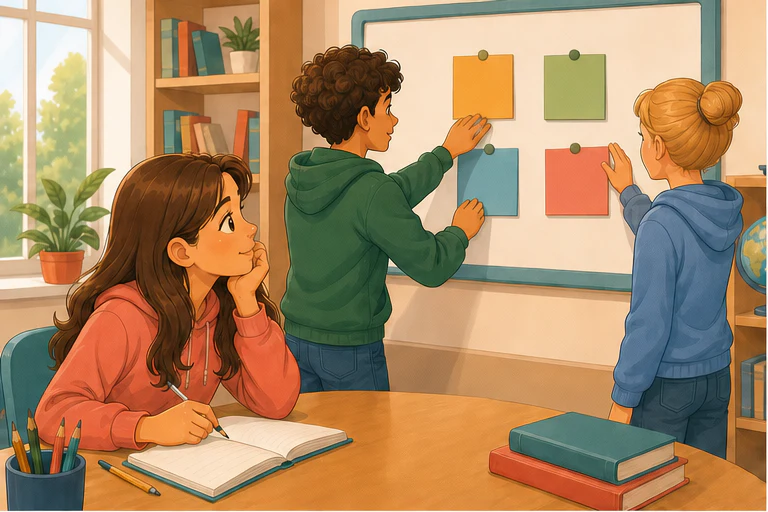
Uczniowie przygotowują tablicę projektową. Jeśli ważne jest, kto wykonuje czynność, używamy strony czynnej.
The students prepared the display.
 Zapisz się
Strona bierna
W stronie biernej Maja nie pyta najpierw, kto coś zrobił. Patrzy na to, co stało się z rzeczą, osobą albo miejscem: projekt został przygotowany, doniczka została przewrócona, zaproszenia zostaną wysłane.
Historia Mai
Uczniowie przygotowują tablicę projektową. Jeśli ważne jest, kto wykonuje czynność, używamy strony czynnej.
The students prepared the display.

Doniczka leży przewrócona, ale nie wiemy, kto to zrobił. Najważniejszy jest skutek, więc naturalna jest strona bierna.
The plant was knocked over.

Maja widzi, że czas pokazuje forma be: is, was, will be, has been. Czasownik po niej zostaje w III formie.
The room is cleaned. The room was cleaned. The room will be cleaned.

Przy zaproszeniach, certyfikatach, raportach i wydarzeniach często ważniejszy jest efekt niż osoba, która wszystko zrobiła.
The certificates will be prepared before the event.
Sens konstrukcji
Podmiot wykonuje czynność. Zdanie odpowiada na pytanie: kto coś zrobił?
Wykonawca + czasownik + reszta
The teacher checks the tests.
Someone broke the window.
Rzecz albo osoba, której coś dotyczy, staje się podmiotem zdania. Skupiamy się na efekcie.
Obiekt + be + III forma + by + wykonawca
The tests are checked by the teacher.
The window was broken.
Konstrukcja
Obiekt + be w odpowiednim czasie + III forma / +ed
English is taught in this school.
The room was cleaned yesterday.
Obiekt + be + not + III forma / +ed
The room is not cleaned on Sundays.
The report has not been finished yet.
Be / has / will + obiekt + III forma / +ed?
Is English taught here?
Was the window broken?
Użycie
Sprawca jest nieznany albo nie ma dowodu, kto coś zrobił.
The plant was knocked over.
Liczy się rezultat, a nie osoba, która wykonała czynność.
The room is cleaned every day.
Nie trzeba go podawać, bo każdy rozumie, kto zwykle to robi.
English is taught in this school.
W raportach, instrukcjach i opisach procesów często skupiamy się na czynności.
The experiment was conducted carefully.
Czasy
am / is / are + III forma
The room is cleaned every day.
am / is / are being + III forma
The room is being cleaned now.
has / have been + III forma
The room has been cleaned.
was / were + III forma
The room was cleaned yesterday.
was / were being + III forma
The room was being cleaned at 5 p.m.
had been + III forma
The room had been cleaned before we arrived.
will be + III forma
The invitations will be sent tomorrow.
am / is / are going to be + III forma
The project is going to be presented soon.
can / must / should be + III forma
The homework must be finished today.
Pytania i przeczenia
Is / was / has / will + obiekt + III forma?
Is the room cleaned daily?
Has the letter been sent?
What / when / where + be + obiekt + III forma?
When was the school built?
Where are the books kept?
Obiekt + be + not + III forma
The room is not cleaned on Sundays.
The work will not be finished today.
By + wykonawca
Jeśli wykonawca wnosi istotną informację, dodajemy go po by.
The book was written by J.K. Rowling.
The project was prepared by our class.
Nie dodajemy by someone, by people ani informacji, która nic nie zmienia.
The window was broken.
The room is cleaned every day.
Uwaga
The room cleans every day.
PoprawnieThe room is cleaned every day.
The window was break.
PoprawnieThe window was broken.
English is teach here.
PoprawnieEnglish is taught here.
The invitations will sent tomorrow.
PoprawnieThe invitations will be sent tomorrow.
Praktyka
Propozycja kolejności